Automatic fish feeders help maintain a consistent feeding schedule when you’re away, reducing stress for both pets and owners. This guide compares top options designed for various tank sizes, power sources, and feeding frequencies. The selections emphasize moisture resistance, reliable timers, and user-friendly setups to fit most home aquariums.
| Product | Capacity / Feeding | Power | Key Benefit |
|---|---|---|---|
| Petbank Automatic Fish Feeder (Moisture-Proof) | 16 grids, up to 15 meals | USB Rechargeable | Moisture-sealed design, precise portioning |
| DXOPHIEX Automatic Fish Feeder | Flexible intervals: 8h / 12h / 24h | Battery or USB | Dual power options, simple mounting |
| FISHNOSH Automatic Fish Feeder (New Gen) | Up to 9 feedings per day | Battery-free option (manual accessible) | Clear setup, reliable daily routine |
| FREESEA Automatic Fish Feeder | Open design for adjustable portions | Battery or USB compatible | Moisture-proof, manual plus automatic modes |
| Aoyar Automatic Fish Feeder | Three fixed modes, 200ml capacity | Battery | Three feeding modes, moisture protection |
Note: All products listed are suitable for a range of small to mid-sized aquariums, including bettas, tetras, and community tanks. Always match feeder capacity to your tank’s feeding needs and the type of food you use (pellets, flakes, or strips) to avoid clumping or overfeeding.
Petbank Moisture-Proof Automatic Feeder

Petbank’s feeder uses 16 feeding grids to deliver up to 15 individual portions, each grid holding about 2g for accurate dosing. It features two setup methods: adjustable clamp base mounting or suction cup attachment for tanks with lids. The design is fully sealed to resist moisture, helping prevent food from sticking or jamming. It works with particles, pellets, powders, and small strips, but is not intended for shrimp or flakes. This model includes a USB rechargeable power option and an LCD display for easy programming.
DXOPHIEX Automatic Feeder With Battery And USB

DXOPHIEX offers automatic feeding at 8/12/24 hour intervals, with a choice of two power sources: AA batteries (not included) or USB power. A 6.6-foot USB cable is included, and both power options can be used simultaneously for outages. The feeder can be fixed on the edge of the tank or on the tank hood, depending on your setup. This versatility makes it suitable for a wide range of aquariums, including those without a hood.
FISHNOSH New Generation Auto Feeder

FISHNOSH’s 2025 model emphasizes a stress-free feeding routine with programmable schedules that support up to 9 feedings per day. The design is straightforward, with a clear user guide and an intuitive refill process. It is well-suited for small tanks, large aquariums, and ponds, offering reliable daily meals without requiring advanced programming. The unit supports multiple feeding styles, though it lacks a built-in display in some variants, relying on simple timer operations for ease of use.
FREESEA Automatic Feeder With Manual And Auto Modes
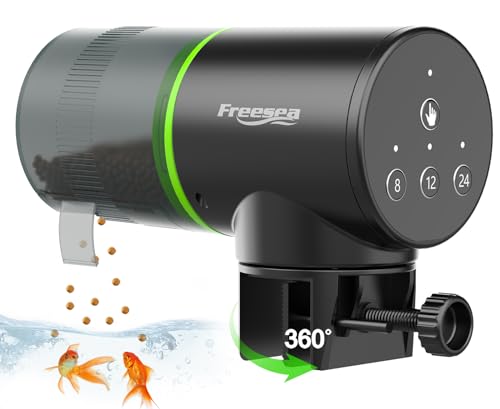
FREESEA offers both manual and automatic feeding options with adjustable intervals at 8h, 12h, and 24h. The design features a moisture-resistant mechanism to help prevent clumping and blockage, and the top opening can be pressed to regulate the amount of food released without removing the timer. Its versatile feed compatibility includes strips, powder, granules, and flakes, making it a flexible choice for many hobbyists who want quick adjustments during travel or busy days.
Aoyar Automatic Feeder With Three Modes

The Aoyar feeder is designed with three fixed feeding modes and a 200ml capacity, suitable for holiday vacations or longer trips. It supports automatic feeding at 8/12/24 hour intervals with an optional manual feeding mode. The device includes an upgraded moisture-proof lid to minimize moisture exposure and food clumping, helping maintain food freshness during extended outages or travel.
Buying Guide: Key Purchase Considerations
When selecting an automatic fish feeder, consider the following from multiple perspectives to ensure a good match for your aquarium and routine.
- Tank compatibility: Check the mounting method (clamp vs. suction) and whether the feeder fits open-top tanks, tanks with hoods, or rimless setups. A secure fit reduces the chance of spills.
- Feeding schedule and capacity: Determine how many feedings per day you need and how much food to dispense per portion. Larger tanks or schooling fish may require more frequent or larger portions.
- Power options: Decide between USB, battery, or dual power sources. USB provides convenience, while batteries ensure operation during outages.
- Food compatibility: Ensure the feeder works with your preferred food type (pellets, flakes, powders, strips). Some designs handle moisture better than others, reducing clumping.
- Moisture protection: A moisture-sealed design prevents jammed openings and keeps food dry, which extends shelf life and reduces waste.
- User-friendliness: Look for intuitive controls, clear displays, and simple refilling mechanisms. A straightforward setup saves time and reduces errors.
- Durability and warranty: Consider build quality, materials, and manufacturer support. A longer warranty provides peace of mind for long-term use.
- Maintenance: Check how easy it is to clean and refill, and whether the device can operate with minimal disassembly.
For best results, match the feeder features to the specific needs of your fish and tank environment. Betta and small tropical fish often benefit from precise portioning and moisture protection, while larger community tanks may require higher capacity and more frequent feedings. Always monitor fish behavior after a new feeder installation to fine-tune schedule and portions.