The right reptile thermostat helps maintain safe, stable temperatures essential for healthy bearded dragons, geckos, snakes, and other terrarium pets. This guide highlights five reliable options designed for heating mats, lamps, and home-use incubations. Each product is chosen for precise control, user friendliness, and reliability in American households. Read on to compare features, setup ease, and how each model supports stable day/night temperature cycles in a reptile habitat.
Summary table of chosen products
| Product | Brand | Temp Range | Notable Feature |
|---|---|---|---|
| BN-LINK Digital Heat Mat Thermostat Controller | BN-LINK | 40-108°F (4-42°C) | Easy 3-button setup; bright display; rugged sensor cord |
| REPTIZOO Dimming Thermostat, PID | REPTI ZOO | 41°F to 140°F (5°C to 60°C) | Precise dimming with stable PID control |
| Inkbird ITC-306T Pre-Wired Thermostat | Inkbird | Ambient sensing; up to 1200 W output | Dual display; day/night cycles; alarms |
| Inkbird IPT-2CH WiFi Reptile Thermostat | Inkbird | Varies by device; supports multiple outlets | Two outlets with separate probes; app monitoring |
| LUCKY HERP Reptile Dimming Thermostat | LUCKY HERP | 68°F to 122°F (20°C to 50°C) | PID dimming with LED display; memory function |
BN-LINK Digital Heat Mat Thermostat Controller

The BN-LINK thermostat is designed for heating devices such as reptile heating mats and heat lamps. It features an effortless 3-button setup with Fahrenheit/Celsius switching, a bright display, and indicator lights for status visibility in low light. Its rugged construction includes a sensor probe and a 4.92 ft temperature probe, making it versatile for multiple terrarium layouts. Suitable for entry-level reptile habitats or seed germination setups, this model emphasizes straightforward operation and dependable performance.
REPTIZOO Dimming Thermostat
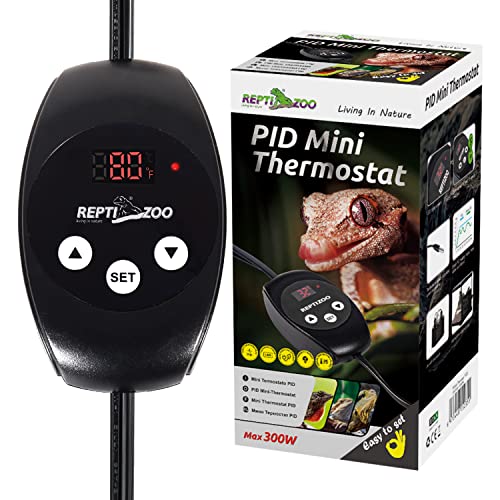
This dimming thermostat uses a precise PID control method to modulate heat lamp output, providing stable temperatures and longer bulb life. It’s designed for heating lamps and other heaters, with a temperature range from 41°F to 140°F. The device includes a highly accurate sensor for real-time adjustments and a user-friendly LED display that can show ambient and set temperatures in Celsius or Fahrenheit. While excellent for light-based heating, it is not recommended for sunlamps and focuses on controlled, gradual temperature changes to mimic natural habitats.
Inkbird ITC-306T Pre-Wired Electronic Thermostat

The Inkbird ITC-306T offers a plug-and-play design with dual display windows and support for Celsius or Fahrenheit readings. It provides over-temperature and sensor fault alarms, and can output up to 1200 W. Its dual time cycles setting allows different temperatures for day and night, making it suitable for hatchings, bearded dragons, and other reptiles requiring circadian rhythm maintenance. The pre-wired setup reduces installation complexity, making it a popular choice for hobbyists and small terrariums alike.
LUCKY HERP Reptile Dimming Thermostat
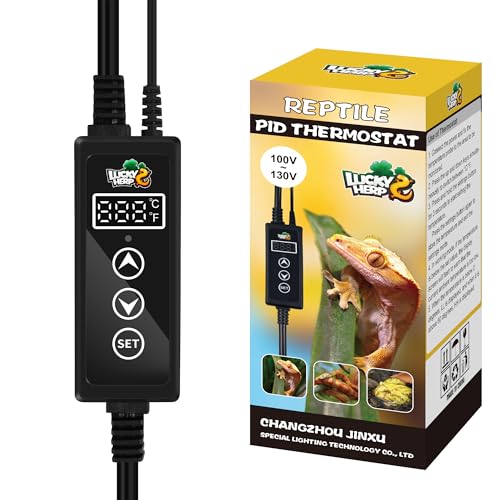
LUCKY HERP offers a PID-based dimming thermostat with an LED display and memory function. Its temperature control range of 68°F to 122°F makes it suitable for many reptile species, delivering stable temperature with smooth transitions. The device emphasizes precise regulation to minimize fluctuations, which benefits reptile health and enclosure stability. Easy setup involves fixing the probe, connecting the heater, and programming the target temperature, with °C/°F switching for user convenience.
Pymeter Digital Temperature Controller

Note: This product is included for comparative context and is a dual-sensor, dual-outlet option capable of managing two separate zones. Each outlet can be set to turn on and off at different temperatures, enabling independent regulation of multiple heaters or cooling devices. It supports two waterproof sensors and offers alarms for high/low temperatures and differences, which helps maintain precise climate conditions in complex terrarium setups.
Buying Guide: Key Considerations For Reptile Thermostats
- Temperature range and stability: Match the device to your terrarium’s species-specific needs. Reptile habitats often require tight control with small degree changes impacting comfort and health. Look for PID or dimming controls for smoother transitions.
- Outlets and probes: If you have multiple heaters, choose models with multiple outlets or dual sensors. Independent control reduces cross-interference and helps maintain uniform temps across zones.
- Power handling: Check maximum wattage per outlet and total load capacity to ensure compatibility with your heat mats, lamps, and accessories. Overspecifying avoids tripped breakers and device damage.
- Ease of setup and monitoring: A clear display, simple interfaces, and alarms (high/low) help prevent accidental overheating. WiFi-enabled models offer remote monitoring, but require app familiarity and network reliability.
- Durability and placement: For terrarium use, consider models with robust probes and cords. Ensure probes are placed in the enclosure in ways that accurately reflect ambient temperatures around basking sites and cooler corners.
- Energy efficiency: Dimming and PID-based thermostats typically conserve energy by avoiding abrupt on/off cycles, reducing wear on heating elements and bulbs.
- Safety features: Look for over-temperature alarms, sensor fault alerts, and robust protective housings to safeguard both pets and equipment.
- Compatibility: Verify that the device is rated for your region’s voltage (commonly 110–120V in the U.S.) and that the enclosure setup allows safe cord routing and placement.
In any terrarium setup, a thermostat is part of a broader climate-control system. Pair a reliable thermostat with proper lighting schedules, humidity controls, and substrate management to create a stable environment that supports healthy reptile behavior and metabolism. Always follow manufacturer guidelines for installation and monitor temperatures with a reliable thermometer or infrared device to confirm the controller’s performance over time.